January 1945
Twenty-five Military Intelligence Service Nisei specially trained in low-level radio intercept join the 6th Radio Squadron Mobile in Assam, India.
February 19, 1945
Several MIS Nisei soldiers land with the US Marines on Iwo Jima, one of the last battles in the Pacific. A total of about 50 MIS Nisei join the fighting there. Nisei are also present in the Tinian Island operation.
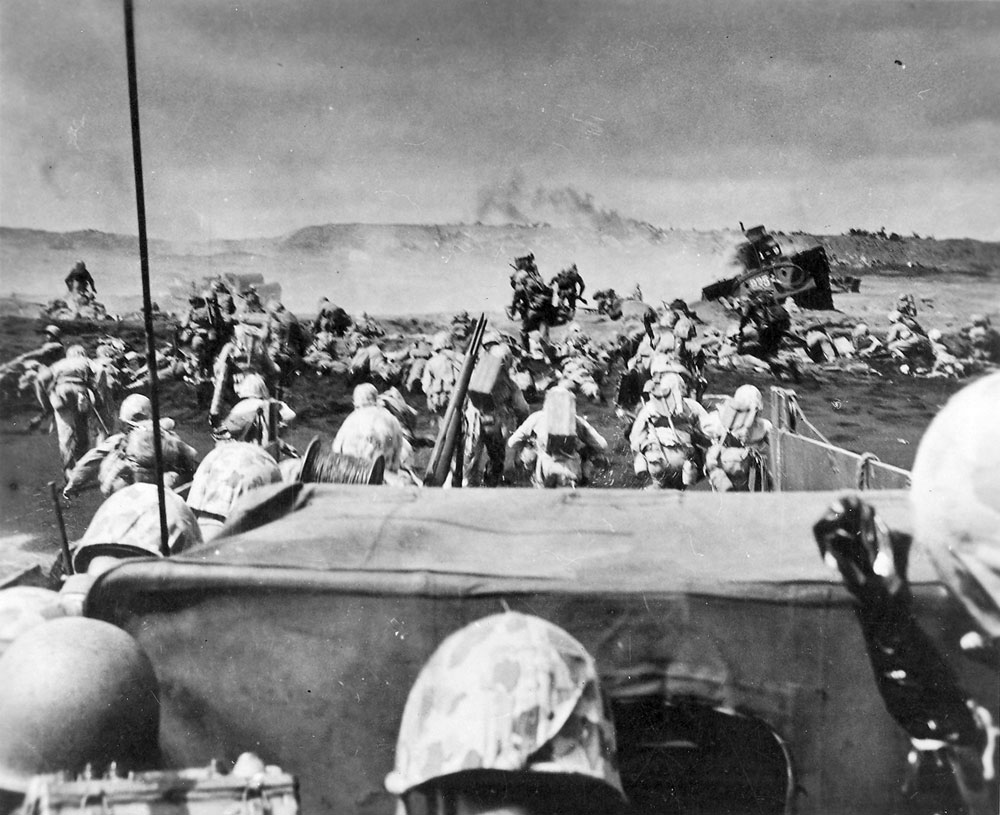
Landing at Iwo Jima. Courtesy of the United States Department of Defense.
March 12, 1945
The 522nd Field Artillery Battalion becomes a roving battalion, first sent to assist the 63rd Division’s assault on the Siegfried Line between Eastern France and Germany.
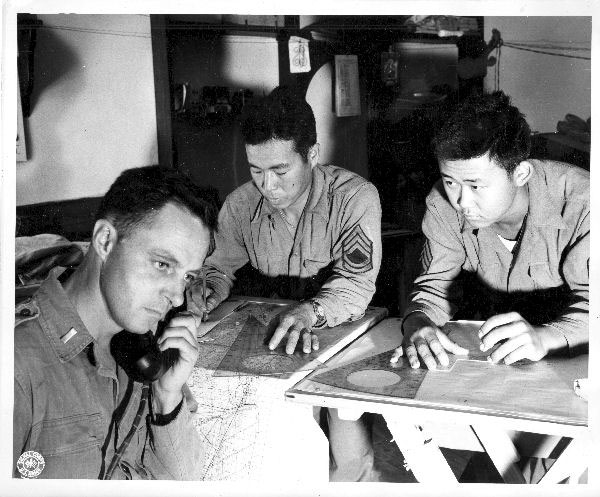
Members of the 522nd Field Artillery Battalion working in the fire direction center. Courtesy of the United States Army Signal Corps.
March 20, 1945
The 100th Infantry Battalion/442nd Regimental Combat Team, less the 522nd Field Artillery Battalion, leaves France for Italy to join the all African American 92nd Infantry Division.
Late March 1945
The 522nd is assigned to the 44th and 45th Divisions in their drive for Mannheim, Germany.
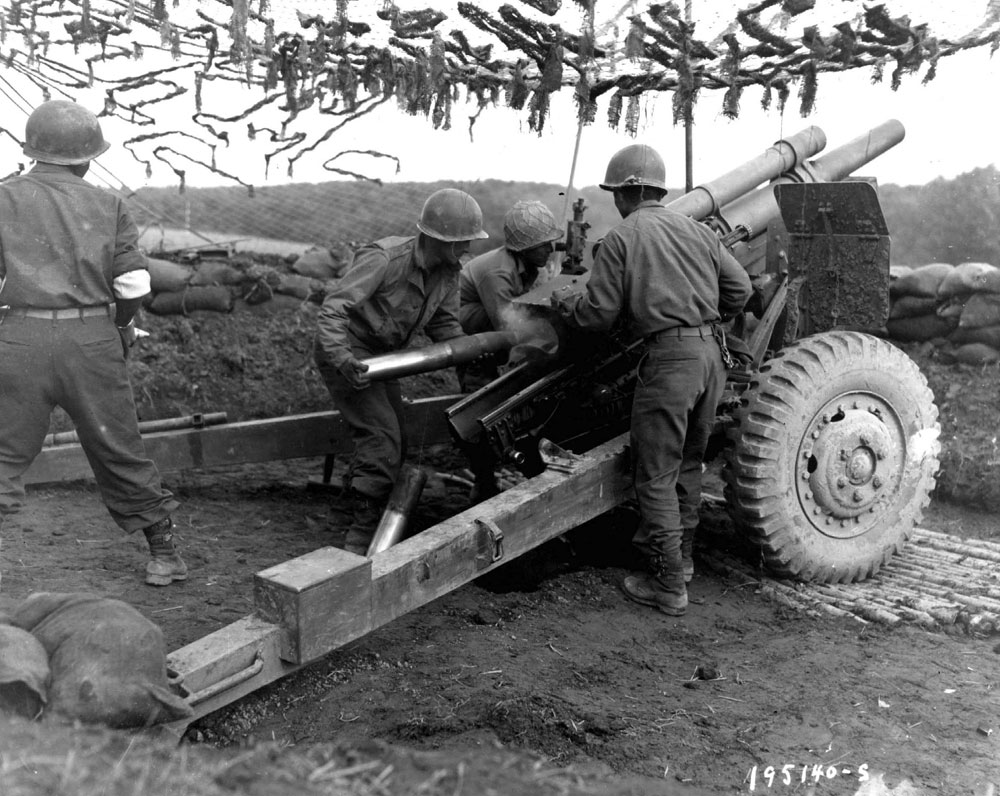
Members of the 522nd Field Artillery Battalion. Courtesy of the United States Army Signal Corps.
April 1, 1945
The battle of Okinawa begins. MIS Nisei had accompanied the 77th Infantry Division when they landed in the Kerama Islands. They then are with the Tenth Army when they land on Okinawa. They assist with cave flushing, the interrogation of prisoners, and the translation of Japanese documents, which reveals defense plans, troop positions, and maps of artillery positions.

Warren Higa questions a Japanese prisoner on Okinawa. Courtesy of the United States Army Signal Corps.
April 5-6, 1945
100th/442nd RCT makes a surprise attack on Nazi mountainside positions in Italy, breaking through the Nazi Gothic Line in one day.
An aerial view of part of the Nazi’s Gothic Line. Courtesy of the United States Army.
April 6, 1945
100th/442nd RCT begins to drive the enemy up the Italian coast to Genoa and Turin.
April 29, 1945
The 522nd Field Artillery Battalion helps to liberate Jewish prisoners of a Dachau sub-camp and a death march outside of Waarkirchen, Germany.

Liberated Dachau prisoners cheer American troops. Courtesy of the US Government.
May 2, 1945
German Army surrenders in Italy.
May 8, 1945
The war in Europe is over.
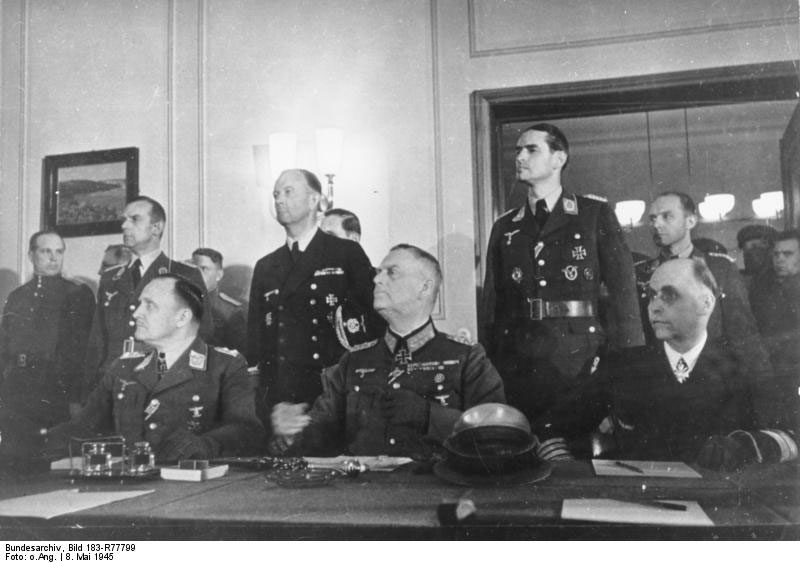
Germany surrenders. May 8, 1945. Courtesy of the German Federal Archive.
May 28, 1945
The first Women’s Army Corps class at the Military Intelligence Service Language School begins with 28 women students.1
July 1945
The MARS Task Force disbands.

The MARS Task Force makes its way through the hills toward the Burma Road. January 1945. Courtesy of the United States Department of Defense.
August 6, 1945
The Americans drop the first atomic bomb on Hiroshima.

The atomic bombing of Hiroshima. Courtesy of the United States Department of Defense.
August 9, 1945
The US drops its second atomic bomb on Nagasaki, essentially bringing the war against Japan to an end. As Japanese forces surrender, Office of Special Services Detachment 202 sends teams with Nisei translators to conduct rescue missions for Allied POWs in China, Korea, Hainan Island and Formosa (now known as Taiwan).

The MARS Task Force makes its way through the hills toward the Burma Road. January 1945. Courtesy of the United States Department of Defense.
August 1945
MISers begin their participation in the surrender and seven-year occupation of Japan. More than 5,000 MIS Nisei are involved in processing war crimes, repatriation of Japanese soldiers and civilians, civil censorship, land reform, government reorganization and the rewriting of Japan’s constitution
September 2, 1945
Japan formally surrenders to the US and the Allies. World War II ends.
Throughout the Pacific region, Japanese troops surrender to Allied forces through the month of September.
Throughout the Pacific region, Japanese troops surrender to Allied forces through the month of September.
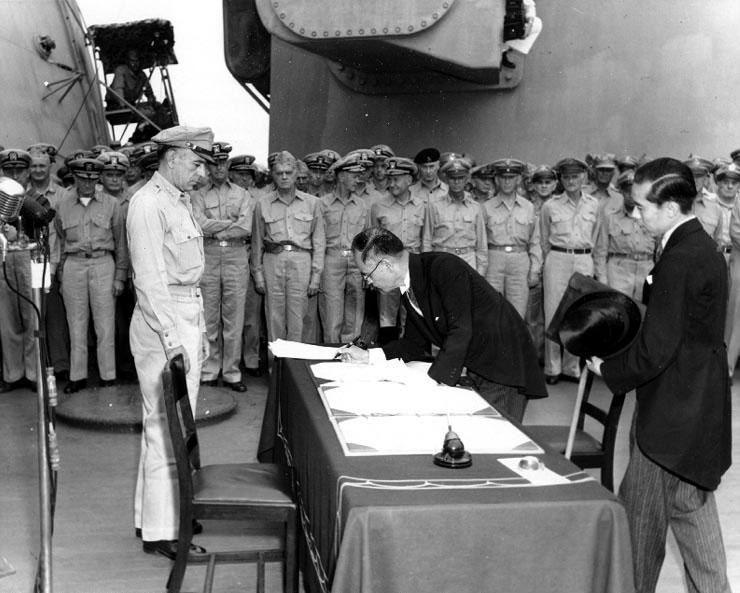
Japanese Foreign Minister Mamoru Shigemitsu signs the Instrument of Surrender on board the USS Missouri. Lieutenant General Richard K. Sutherland, US Army, watches. September 2, 1945. Courtesy of the United States Army Signal Corps.
September 4, 1945
The Western Defense Command proclaims that all military restrictions and exclusion orders against those of Japanese descent are rescinded.2
September 8, 1945
Nisei language teams accompany American units landing at Inchon for occupation duty in southern Korea.3
The 1st Cavalry Division, accompanied by MIS Nisei, becomes the first American unit to enter Tokyo after the surrender.
The 1st Cavalry Division, accompanied by MIS Nisei, becomes the first American unit to enter Tokyo after the surrender.
October 8, 1945
The trial of General Tomoyuki Yamashita, the first major war crime trial of the Pacific war, begins in Manila. Nisei are assigned as interpreters under the Navy and also on the defense and prosecution teams.

General Tomoyuki Yamashita



.png)
