Exhibition Educator Guide

The exhibition guide explores the experiences of Americans of Japanese ancestry during World War II, highlighting the stories of incarceration, military service, and the everyday acts of resilience that shaped American history. Educators will be able to incorporate the exhibition content with classroom-ready materials, guiding questions, and primary-source videos from Go For Broke National Education Center's Hanashi Oral History Collection.

Learning Objectives

Students will be able to:

  • Understand the impact of World War II on Americans of Japanese Ancestry, including incarceration and military service
  • Analyze firsthand accounts as primary sources
  • Explore how geography shaped wartime experiences
  • Examine themes of courage, resilience, and cross-cultural understanding
  • Reflect on how these histories connect to contemporary issues of identity and civil rights

Using this Resource

This page is designed for:

  • Middle school, high school, and introductory college courses
  • U.S. history, ethnic studies, and civics classrooms
  • Museum visits, virtual learning, or independent study

Each section includes:

  • Short historical context
  • Embedded Hanashi Oral History Collection videos
  • Guided discussion questions
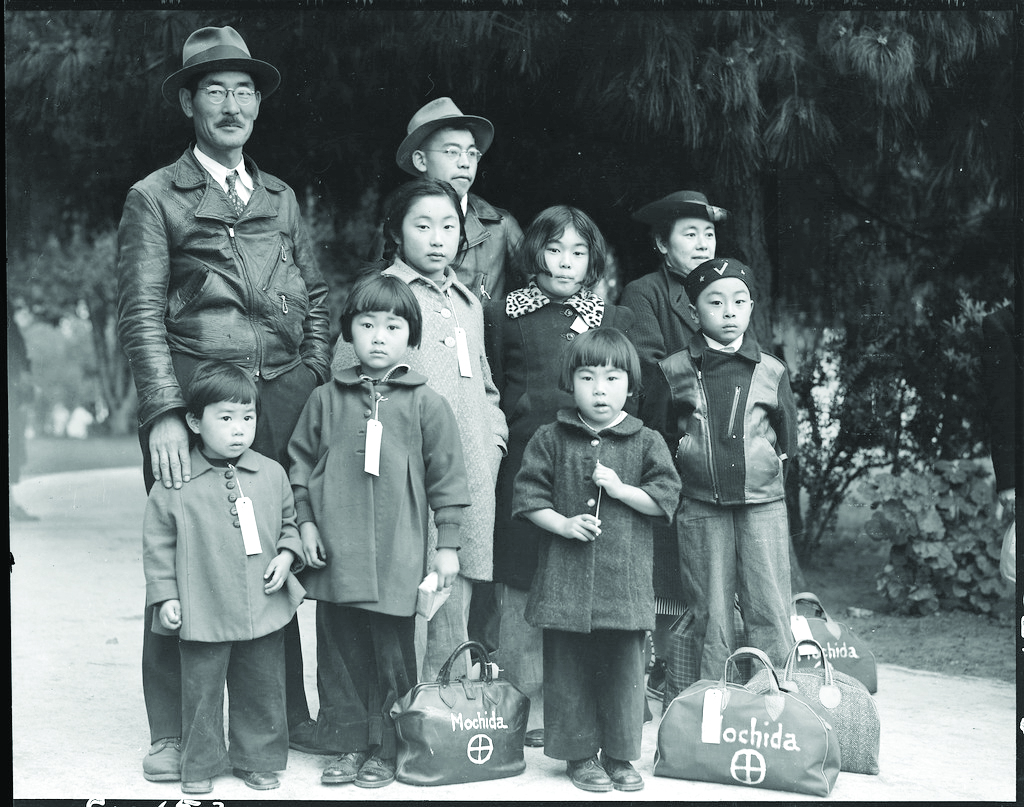
Hayward, California. Members of the Mochida family awaiting evacuation bus. Identification tags are used to aid in keeping the family unit intact during all phases of evacuation.
Courtesy of the National Archives and Records Administration.
Following the attack on Pearl Harbor, the U.S. initially banned Japanese Americans from serving in the military but reversed the policy in January 1943. In total, over 33,000 young Japanese American men and women volunteered, or were drafted, into the U.S. Army. They served in the 100th/442nd Regimental Combat Unit, a segregated Japanese American unit, and in the Military Intelligence Service. At the same time, Japanese American women stepped forward to serve in the Women’s Army Corps, Army Nurse Corps, and Cadet Nurse Corps, taking on essential non-combat roles that supported the war effort.

From incarceration to service

The incarceration of Japanese Americans living on the West Coast of the mainland United States during World War II was a wholesale denial of civil rights. Approximately 120,000 Japanese Americans, two-thirds of whom were American citizens by birth, were forced from their homes for no reason other than their ancestry.

On February 19, 1942, President Roosevelt issued Executive Order 9066, which paved the way for the removal of Japanese Americans from the West Coast. Executive Order 9066 did not specifically mention Japanese Americans; it instead gave the secretary of war and his commanders the power "to prescribe military areas in such places and of such extent as he or the appropriate Military Commander may determine, from which any or all persons may be excluded." Executive Order 9066, however, was quickly used to incarcerate individuals of Japanese ancestry, with no evidence of crimes having been committed and without due process.

Japanese Americans were given between a few days and a few weeks to pack what they could carry and sell or store the rest. They then boarded buses that took them first to temporary detention facilities, referred to as "assembly centers," where they would be held until more permanent camps, in unknown locations, were completed.

Hear first-person perspectives from Japanese Americans about why they chose to serve during World War II, even as many of their families were confined behind barbed wire in American concentration camps.

Discussion Questions

  • Why might both men and women choose to serve during this time?
  • What does this decision reveal about identity and belonging?
  • How do you define courage in this context?

Optional Activity

Ask students to compare two perspectives:
  • A soldier serving in combat
  • A woman serving in a support role
How do both reflect courage and contribution?

Training and Transformation

After entering military service, Japanese American recruits underwent intensive basic training designed to prepare them for the uncertainties of war. This training was both physical and psychological. Soldiers were taught to handle a wide range of weapons, from rifles to heavier equipment, while also learning discipline, coordination, and obedience to command. Daily routines included long marches, drills, and repeated exercises meant to build endurance and readiness.
For many, this period marked a dramatic shift. Just months earlier, they had been living as civilians, and in many cases, confined in incarceration camps. Training demanded that they quickly adapt to a structured military environment where even small mistakes could carry consequences. Through this process, recruits not only learned technical skills, but they were also shaped into soldiers expected to rely on one another under pressure.

Basic training at Camp Shelby. Nisei soldiers throwing fragmentation grenades. Camp Shelby, Mississippi. 1943.
Courtesy of the Seattle Nisei Veterans Committee and the U.S. Army Signal Corps.
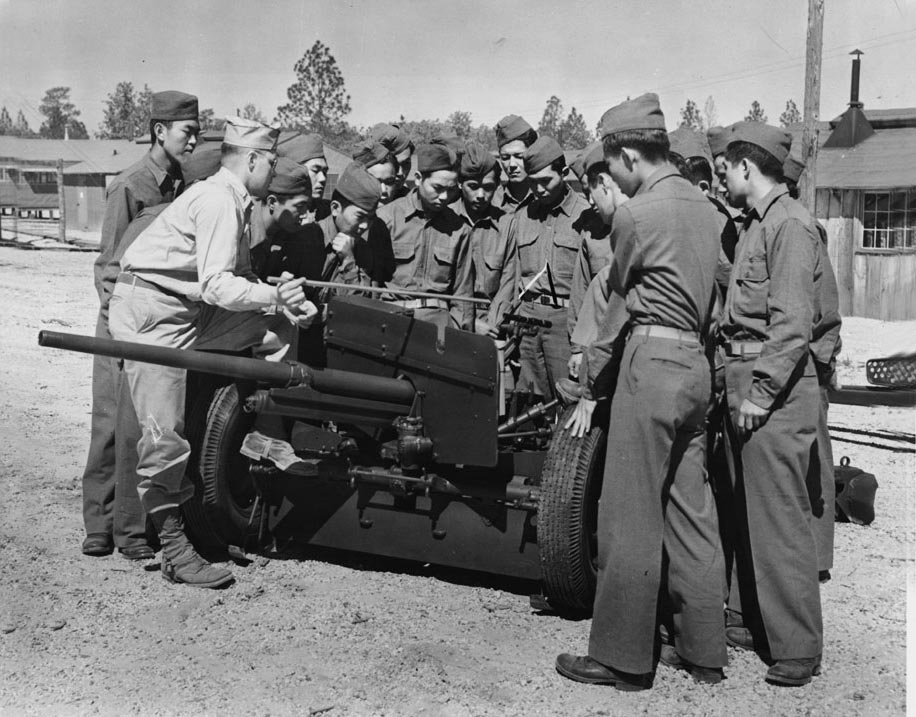
442nd Regimental Combat Team, Anti-Tank Training.
Courtesy of the U.S. Army.
Sam Terasaki reflects on the friendships formed during basic traing and how those bonds stayed with him throughout the war.


Discussion Questions

  • Who were the soldiers training together?
  • What brought them closer together as a group?
  • What moments help build their friendship?

Encounters and Understanding

Military service brought Japanese American soldiers into contact with people from across the United States, often in environments far different from their home communities. These encounters exposed them to a wide range of perspectives, cultures, and social realities. At the same time, service members navigated their own identities in a country where their loyalty had been questioned.
Interactions with others — whether through shared work, conversation, or daily routines — sometimes revealed differences in background and experience. In other moments, they created opportunities for connection and mutual understanding. These encounters highlight how relationships formed under challenging circumstances could foster empathy, challenge assumptions, and build unexpected bonds.
    A group of Nisei WACs receive a briefing from a U.S. Army officer.
    Courtesy of the U.S. Army Signal Corps.
    Vietnam War veteran Jason Young recounts a story shared by World War II veteran Noboru “Don” Seki about finding connection across communities during training. The story highlights how shared experiences can create understanding in unexpected ways.


    Discussion Questions

    • What can we learn from moments of unexpected connection?
    • How can shared experiences bring people together?
    • Where do you see compassion in this story?

    Optional Activity

    Have students discuss:
    • Can hardship create understanding between different groups? Why or why not?

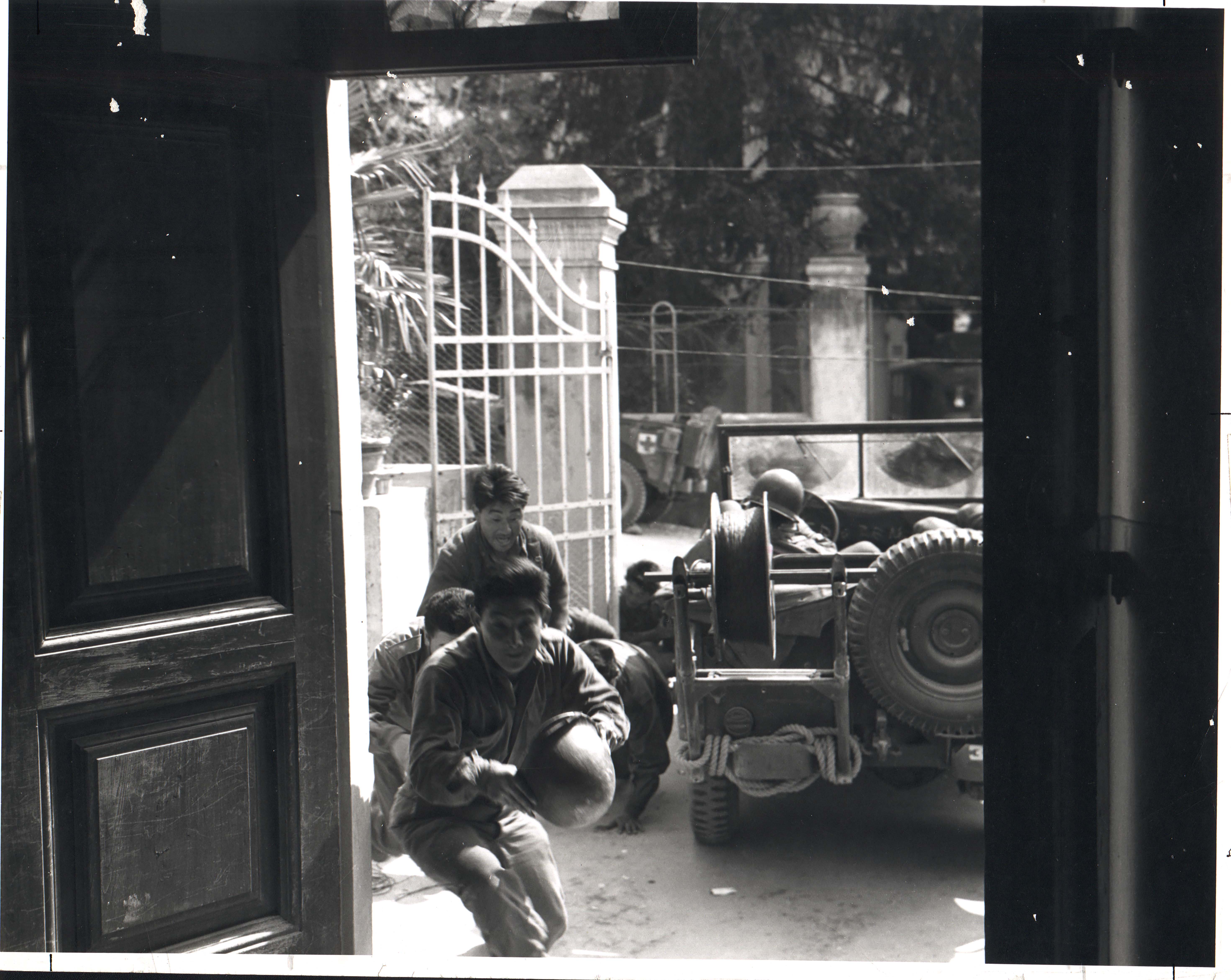
    Entrenched along the rugged Apennine Mountains of Italy, the Allies faced steep terrain rising up to 3,000 feet. When it appeared to be an impossible task for the U.S. military to break this last German stronghold from the air and artillery, General Mark Clark requested that the 442nd attempt a breaking of the defense.
    Nisei of the 442nd Regimental Combat Team run for cover as a German artillery shell is about to land outside the building. Italy. April 4, 1945.
    Courtesy of the National Archives and Records Administration.

    Courage in Action

    Japanese American soldiers served in some of the most demanding and dangerous conditions of World War II. Units such as the 100th Infantry Battalion and the 442nd Regimental Combat Team carried out missions that required endurance, coordination, and resilience. Fighting in unfamiliar terrain and under constant threat, soldiers depended on their training and on one another to complete their objectives.

    Their actions in combat demonstrated courage in many forms. This included not only facing physical danger but also maintaining focus, supporting fellow soldiers, and continuing forward despite uncertainty. The success of these units was built on trust and cooperation, as each individual’s role contributed to the safety and effectiveness of the group.
    Learn about the critical role the 442nd RCT played in the April 1945 collapse of the Gothic Line.


    Discussion Questions

    • What does courage look like in difficult situations?
    • How do teamwork and trust play a role in survival?
    • What might have motivated these soldiers to keep going?

    Optional Activity

    Ask students to define:
    • Is courage something you feel, something you do, or both?

    Service Beyond the War

    For many Japanese American veterans and community members, service did not end when the war was over. Returning home, they faced the challenge of rebuilding their lives while also confronting the legacy of wartime incarceration. In the decades that followed, individuals and organizations worked to ensure that this history would not be forgotten.
    These efforts included sharing personal stories, educating the public, and advocating for government acknowledgment of the injustice. Their work contributed to a broader movement that eventually led to the passage of the Civil Liberties Act of 1988, which formally recognized the wrongful incarceration of Japanese Americans during World War II.

    This continued commitment reflects another form of service, one focused on justice, memory, and the responsibility to future generations.

    During World War II, Rudy Tokiwa was incarcerated in the Poston concentration campin Arizona. While in camp, he volunteered to serve with the all-Japanese American 442nd Regimental Combat Team. Courtesy of Densho.

    Discussion Questions

    • What does it mean to serve after the war is over?
    • Why is it important to speak out about injustice?
    • How can individuals create change over time?

    Optional Activity

    Ask students:
    • What issues today might require courage and compassion?

    Courage and Compassion Today

    The stories presented in “Courage and Compassion offer more than a historical account. They invite reflection on how individuals respond to challenge, injustice, and change. Through their actions, Japanese American service members and community figures demonstrated that courage can take many forms, from enduring hardship to standing up for others. Compassion, too, appears in both large and small ways, including acts of understanding, empathy, and connection.
    By examining these experiences, students are encouraged to consider how the past informs the present. The questions raised by this history — about identity, fairness, and responsibility — continue to resonate today. Engaging with these stories provides an opportunity to think critically about how we define courage and compassion in our own lives and communities.

    Go For Broke Patch Activity Printout